

A patient’s daughter once stopped me outside the ward, holding her father’s lunch tray like it was proof of neglect. “Why is there no salt in this dal?” He’s already weak, she said. Now we’re taking away the one thing he still enjoys.
Fair question, and I’ve heard some version of it most weeks for years. What she couldn’t see on that tray was a creatinine reading from that morning, a note from the nephrologist about fluid restriction, and a decision our dietitian had made an hour earlier to cut sodium further because his ankles hadn’t gone down. None of that fits on a food tray. From outside the ward, it just looks like bland dal.
That gap between what a diet chart looks like and what went into it is where most of the confusion comes from. Closing it is, honestly, most of what our Diet and Nutrition department at best hospital in Howrah does on any given day.
The Number Nobody Mentions at Admission
A study of 500 ICU patients at an Indian tertiary hospital found that nearly two in five were already malnourished on arrival, scored using the Subjective Global Nutritional Assessment tool (Indian Journal of Critical Care Medicine). A separate review of the wider literature puts admission-stage malnutrition across hospital inpatients generally somewhere between 20% and 50%, and notes that roughly two-thirds of patients who arrive already malnourished decline further during their stay unless someone intervenes (Journal of Human Nutrition and Dietetics).
This doesn’t come up at check-in. Families hear about surgery dates, insurance approval, bed availability. Nobody mentions that a patient walking in already underweight is fighting on two fronts at once — the condition that brought them in, and a body running low on the reserves it needs to repair itself.
The second fight is the quiet one. It doesn’t show up on an X-ray.
What the First-Day Screening Is Actually For
Every inpatient gets screened for nutritional status within a day or two of admission. Not a form filed and forgotten — our dietitians pull recent weight history, ask what appetite has looked like over the past week or two, and cross-check against existing conditions like diabetes or kidney disease that change how a body processes food.
This is where people get flagged who nobody expected to need extra attention. A woman admitted for a hip fracture can look perfectly stable on paper. But if joint pain has kept her from cooking properly for three weeks before the fall, she’s already behind before the surgery even starts. Catching that on day one — instead of noticing it later, when a wound isn’t closing the way it should — changes how the rest of the admission goes.
Same Ward, Same Hour, Completely Different Trays
A cardiac patient and a dialysis patient can be two beds apart, eating at the same time, on entirely different diets. The cardiac chart is built around sodium and fluid, because of blood pressure and the risk of fluid overload. The dialysis chart is built around potassium and phosphorus, because a kidney that isn’t filtering lets those minerals climb between sessions.
Neither is copied from a menu book. Every restriction traces to something specific — protein cut back because urea is climbing, a potassium-rich fruit removed because the last blood panel came back at 5.8 mEq/L against a safe ceiling closer to 4.5.
Regional habits matter more here than most training material accounts for. A Bengali patient used to fish and rice every day, recovering from kidney surgery, still needs that pattern respected in principle while protein and phosphorus are controlled in practice. Hand that patient a template chart built around paneer instead of the fish they’d actually eat, and the tray comes back half-finished. A half-eaten tray defeats the point of writing the chart at all.
When Eating Isn’t an Option
Some patients can’t take food by mouth — after major abdominal surgery, following a stroke that’s affected swallowing, or during critical illness on ventilator support. For them we plan and monitor tube feeding, working out formula composition, rate, and volume with the same care a physician gives a drug dose. Get the rate wrong and a patient aspirates. Get the composition wrong and blood sugar swings within hours. There’s no room to approximate here.
A Chart That Doesn’t Change Isn’t Doing Its Job
Write a diet chart on day one and leave it untouched until discharge, and you’ve built something that stops being useful by day three. Appetite comes back as recovery progresses. Complications show up — blood sugar spikes, albumin drops, ankles swell again. Charts get revisited on rounds, not on a fixed weekly slot, because a renal patient’s potassium can move enough in two days to need an immediate change. Waiting for the scheduled Thursday review isn’t good enough for that.
Where This Fits Inside Shree Jain Hospital
We’re a 130-bedded charitable super-speciality hospital under S.S. Jain Sabha, based in Shibpur, Howrah, empanelled with the West Bengal Health Scheme and Swasthya Sathi. That empanelment detail matters more than it sounds like it should — a dialysis patient admitted on a Swasthya Sathi card gets the same individually worked-out potassium and fluid limits as someone paying privately. The chart doesn’t shift based on how the bill gets settled.
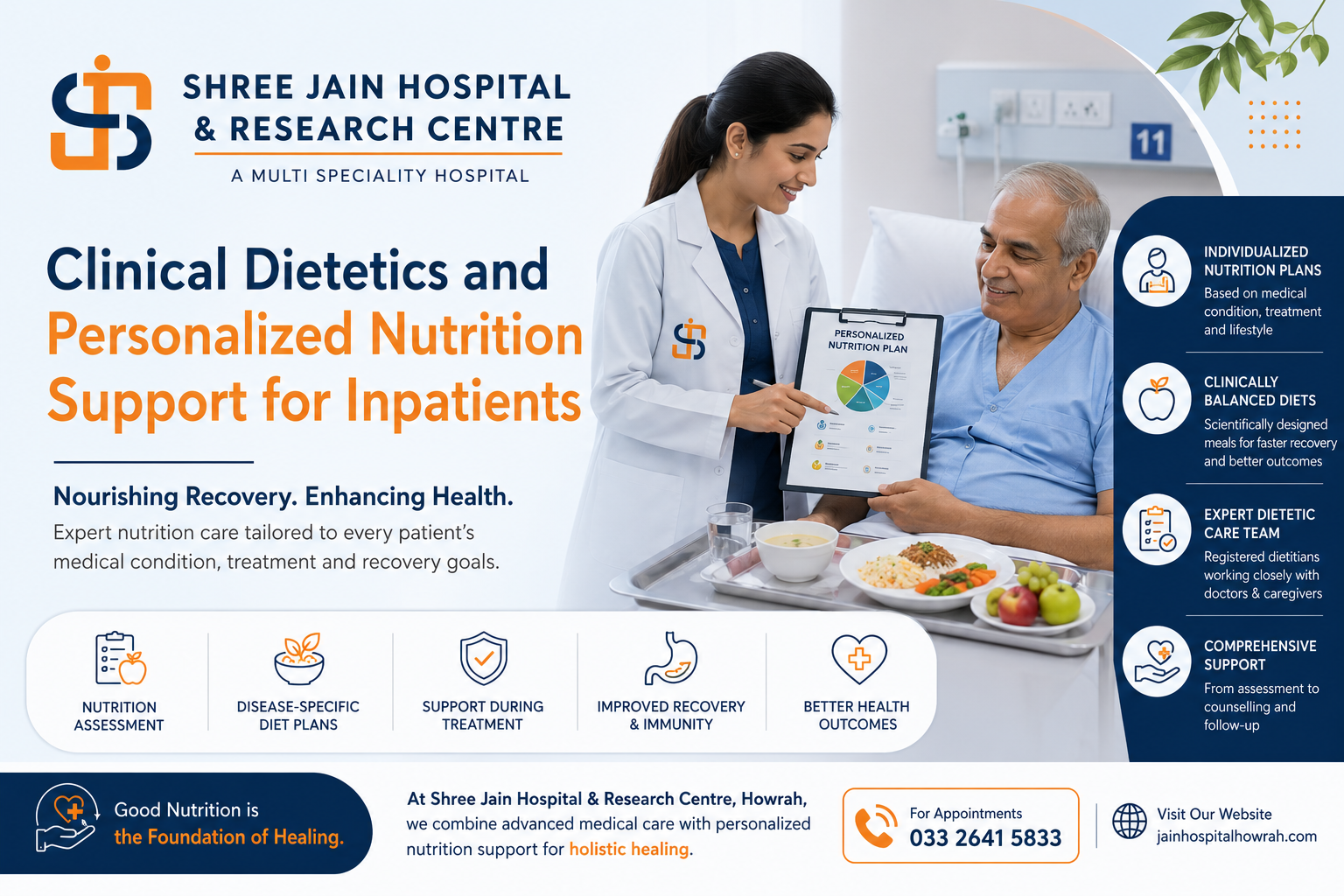
Our dietitians work across cardiology, nephrology, general surgery, and pediatric medicine, because a child recovering from surgery needs calorie-dense, easy-to-digest food to support healing and growth at once, while a dialysis patient two floors down needs something closer to restraint.
We don’t reach for the best hospital in Howrah as a slogan. If we’re going to claim it, we’d rather point at something specific — a dietitian pulling up a creatinine report before touching a chart, instead of sending the same tray to every bed on the floor regardless of what that patient’s kidneys are doing that morning. Repeated across every department, admission after admission, that’s closer to what actually earns a hospital the reputation of being the best hospital in Howrah than any brochure line about equipment.
What Actually Helps Us Help You
Mention allergies, fasting practices, or strong food aversions on day one, not after the wrong tray has already gone up twice. Check before bringing outside food — a homemade snack that looks harmless can throw off a sodium or potassium plan in ways that aren’t obvious from outside the kitchen. If a meal looks unusually restricted, ask why instead of assuming it’s a mistake. Almost always, there’s a specific reason sitting in that morning’s blood report.
Nobody Photographs a Corrected Potassium Level
There’s no discharge story about the chart that got revised on day six because albumin was dropping. But talk to any physician who’s spent real time on a ward, and they’ll tell you recovery isn’t only what happens in the operating theatre. It’s what happens over the following two weeks, three meals a day — and nutrition sits closer to the middle of that than most families realise, until they’re the ones standing outside a ward asking about the salt in the dal.
If you’re planning an admission and want to know how nutrition support would work for a specific condition, our Diet and Nutrition team takes direct consultations — reach them through the Diet and Nutrition department page, or call the hospital’s 24-hour helpline.
Frequently Asked Questions
Why do two patients with the same illness get different diet charts? Because the chart isn’t built around the diagnosis alone. It’s built around that patient’s lab values, weight history, allergies, and whatever else is happening in their body that week — which is rarely identical even for the same condition.
Who’s actually behind the food that shows up on my tray? A qualified clinical dietitian, working from your current lab reports and in direct contact with your treating physician. It isn’t pulled from a fixed hospital menu.
Can family bring in home-cooked food? Ask the dietitian first. Some dishes that seem completely harmless can interfere with a sodium, potassium, or protein limit that’s been set for a specific medical reason.
Does any of this actually shorten a hospital stay? The published literature links adequate, targeted nutrition support to faster wound healing and shorter admissions — particularly for patients who were already nutritionally at risk when they were admitted.
Does WBHS or Swasthya Sathi cover this kind of nutrition support? Yes. It’s built into standard inpatient care here at best hospital in Howrah, not offered as a paid add-on, so it applies the same way whether the admission is under WBHS, Swasthya Sathi, or a private arrangement.