

Nobody asks about biomedical waste when they bring a relative in for a fever or schedule a minor surgery. Fair enough — it’s not dinner-table conversation. But every used syringe, every soiled bandage, every glass vial that leaves an operation theatre has to go somewhere, and how a hospital handles that “somewhere” says more about its real standards than any brochure ever will.
Howrah sits right on the Hooghly, which means anything mishandled here doesn’t stay a local problem for long. Runoff, seepage during the monsoon, waste that ends up where it shouldn’t — it all has a river to travel through eventually. That detail gets left out of most articles on this subject, and it’s exactly why a hospital’s waste protocol carries more weight in a city like this than it might somewhere landlocked. Shree Jain Hospital and Research Centre has built its name as a Renowned Hospital Howrah patients trust partly on this — not the visible, glamorous parts of medicine, but the repetitive, unremarkable discipline of getting waste management right, shift after shift.
It is more than what the overall overview looks like. It specifies what is included in biomedical waste, the rule every hospital falls under it, where most places slip and what kind of regular compliances looks when it is executed well rather than a blunt documentation process where the end result is zero.
What Actually Counts as Biomedical Waste
Most people picture a black bin bag when they hear the term, but it’s narrower and more specific than that. Used needles, blood and body fluids, soiled dressings, expired drugs, lab cultures, tissue from surgical procedures — all of it falls under biomedical waste, and none of it can be treated like regular waste from a kitchen or an office.
Here’s something worth knowing: biomedical waste typically makes up only around 15% of everything a hospital throws out. The rest — packaging, food waste, paper, general refuse — is ordinary municipal waste. That 15% figure matters because it’s usually where hospitals get into trouble. It’s not that facilities can’t tell blood-soaked gauze from office paper. It’s that under pressure, during a busy shift, the wrong bag ends up in the wrong bin, and that one lapse is enough to compromise the entire chain that follows.
Left unmanaged, this waste spreads infection, contaminates water, and puts the people at the bottom of the disposal chain — sanitation workers, waste pickers — at direct risk of needle injuries or exposure to pathogens they never signed up for. India generates upward of 700 tonnes of this waste daily, a number that spiked hard during Covid and never fully came back down. At that scale, there’s no room for a casual approach.
The Rulebook Nobody Reads Until Something Goes Wrong
The governing framework is the Bio-Medical Waste Management Rules, 2016, notified by the Ministry of Environment, Forest and Climate Change, which replaced the older 2011 version. One practical change worth noting: sorting categories were simplified from ten down to four, using a colour code that’s genuinely workable once staff are trained on it, rather than the sprawling older system that was harder to enforce in practice.
| Colour | What Goes In It | How It’s Disposed |
| Yellow | Anatomical waste, soiled dressings, expired medicines | Incineration or deep burial |
| Red | Contaminated plastics — IV sets, tubing, catheters | Autoclaving or chemical disinfection |
| White | Sharps — needles, scalpels | Sterilised and shredded |
| Blue | Glass, metallic implants | Washed, disinfected, recycled |
A few provisions in these rules rarely make it into general write-ups but matter enormously in daily hospital operations. Untreated biomedical waste cannot sit in storage for more than 48 hours — after that window, a hospital either treats it on-site or has it collected by an authorised facility, and any exception has to be reported to the state Pollution Control Board with a stated reason. The rules also required hospitals to phase out chlorinated plastic bags and gloves by March 2019, which is why most compliant facilities now use non-chlorinated alternatives as a matter of course rather than a special initiative. There’s also a bar-code requirement on waste bags and containers, so each batch can be traced from the ward it came from through to final disposal — useful when something needs to be investigated after the fact, and equally useful simply for keeping internal records honest.
Any hospital running more than 30 beds needs a dedicated committee overseeing this internally, and treatment itself doesn’t happen on hospital grounds — waste gets handed to an authorised Common Bio-Medical Waste Treatment Facility instead. In West Bengal, that authorisation is processed through the state Pollution Control Board via the SilpaSathi portal. None of this is optional guidance. It’s law, and inspections do happen.
Where Most Hospitals Actually Fall Short
It’s worth being honest about this instead of pretending compliance is automatic once the rules exist. The common failure points aren’t dramatic — nobody’s dumping waste in the river on purpose. They’re small and procedural: a bin left unlabelled after a supply restock, waste sitting past the 48-hour mark because a pickup got delayed, a night-shift staff member who wasn’t part of the last training session and improvises.
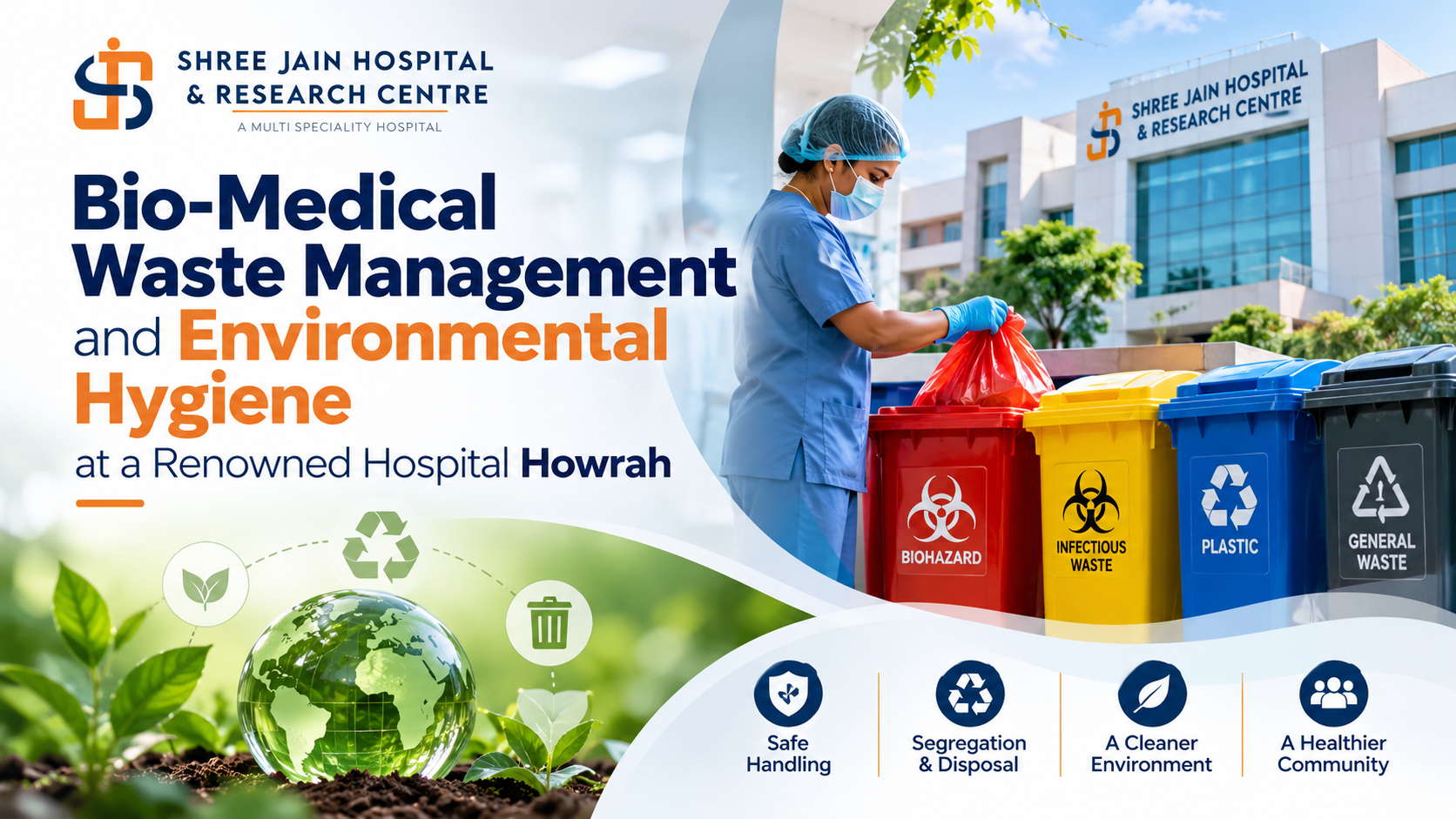
A well-run facility doesn’t get this right through good intentions. It gets there through redundancy — checklists that don’t depend on memory, supervisors who physically check bins rather than trusting reports, and a culture where flagging a mistake doesn’t feel like an invitation for blame. At Shree Jain, segregation starts right at the point of generation — bedside, OT, diagnostic lab — instead of being sorted out later by someone in housekeeping with no idea what went into each bag. Bins are colour-coded and placed in fixed, visible spots in every ward, and staff go through periodic refreshers, not because the rules change often but because habits slip if nobody reinforces them.
Covered trolleys move waste to a storage point away from patient areas, where it’s weighed, logged, and tracked against the 48-hour clock before handover to the treatment facility, with paperwork documenting every step. During monsoon months, storage areas need extra attention too — rainwater pooling near a waste holding point is a separate, unglamorous headache that hospitals across Bengal deal with every year and rarely discuss openly. It’s exactly the kind of detail that separates a Renowned Hospital Howrah residents actually trust from one that simply advertises trust.
Hygiene Is a Bigger Picture Than the Bins
Waste segregation is one piece of it. The rest is what happens to air, water, and surfaces inside the building every hour of the day — ventilation in the OT, how often high-touch surfaces get wiped down, rotating disinfectants so bacteria don’t build up tolerance to whatever’s used on repeat.
Hospital-acquired infections aren’t a rare, theoretical risk. They happen where these routines are treated as optional, and they almost never happen where the basics are followed without exception, week after week, without anyone watching. Wastewater from labs and wards also needs treatment before it leaves the premises — untreated effluent can carry pathogens and pharmaceutical residues straight into the local water table, which matters more here than in most places given how close everything in Howrah sits to the river system.
Why This Reaches Beyond the Hospital Walls
It’s tempting to think of waste management as an internal matter, something that only concerns the hospital and its regulators. But poorly handled biomedical waste doesn’t stay contained. It can end up mixed into municipal waste streams, attract stray animals, or expose waste pickers who never consented to that risk in the first place.
A hospital that gets this right is protecting more than its own patients — it’s protecting sanitation workers, neighbouring residents, and the wider environment around Howrah. That’s part of the quieter, less-discussed reason families in the area keep returning to a Renowned Hospital Howrah institution like Shree Jain: the standards genuinely don’t stop at the hospital gate, even when nobody’s checking.
A Few Honest Questions People Actually Ask
Is biomedical waste management legally mandatory, or just good practice?
It’s mandatory. Under the 2016 Rules, every healthcare facility generating such waste must segregate, store, and dispose of it through authorised channels. Non-compliance can mean fines or, in serious cases, losing the licence to operate.
Why can’t biomedical waste just go out with the regular garbage?
Because municipal waste systems aren’t built to handle anything infectious or hazardous. Mixing the two defeats the entire purpose of segregation and puts sanitation workers directly at risk.
How long can a hospital legally store this waste before disposal?
Generally, no more than 48 hours untreated. If circumstances force a longer window, the hospital has to notify the state Pollution Control Board and justify it — it isn’t discretionary.
Does good waste management actually reflect the quality of care elsewhere in a hospital?
More than people assume. A facility disciplined about something as unglamorous as waste handling is usually disciplined about infection control generally. The two habits tend to travel together, because they both come from the same underlying culture.
Is the waste treated on the hospital premises itself?
No — it’s segregated and safely stored on-site, then handed to an authorised CBWTF for actual treatment and disposal, in line with state pollution board requirements. Hospitals don’t run their own incinerators as a rule.
Last Word
Nobody picks a hospital because of its waste segregation policy, and that’s understandable — it’s not why anyone walks through the door. But if you ever needed a reason to trust one beyond its doctors, this is closer to the real answer than any awards wall could give you. A Renowned Hospital Howrah earns that reputation through the parts nobody sees, done correctly, every single day, without exception — and Shree Jain Hospital and Research Centre has treated that as non-negotiable for as long as it’s been serving this city.
More on the hospital’s services is at jainhospitalhowrah.com.