


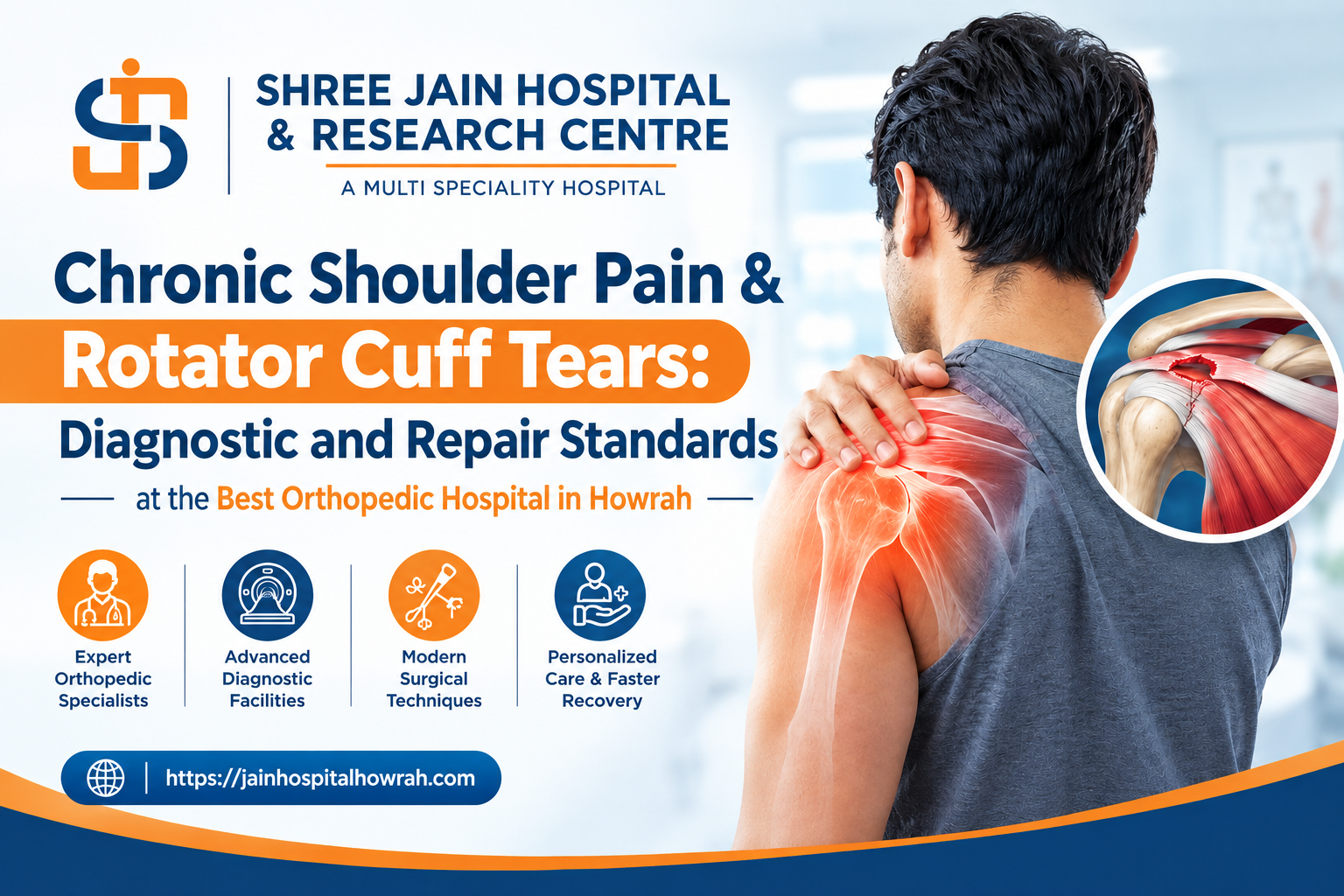
Most people with shoulder pain don’t come in right away. They wait. A dull ache after carrying groceries gets called “slept on it wrong.” Trouble reaching the top shelf gets called getting older. Pain that wakes someone up at 2am gets a painkiller and nothing else, and by morning it’s forgotten again, until the next night. Usually this waiting doesn’t cost much. Sometimes it costs a lot, because a tear left alone for months behaves differently than one caught early, and by the time someone finally comes in, some of the easier options are already off the table.
Below is what actually happens when a rotator cuff problem gets worked up properly, from the first conversation with a doctor to the point where surgery either does or doesn’t enter the picture — roughly the standard you’d expect from the best orthopedic hospital in Howrah, or anywhere else for that matter. If you’re trying to figure out whether your own shoulder needs attention, or you’re just trying to make sense of a diagnosis someone already gave you, this should help.
Four Tendons, Doing a Job Nobody Notices Until It Fails
“Rotator cuff” sounds like one thing. It’s four muscles — supraspinatus, infraspinatus, teres minor, subscapularis — wrapped around the top of the arm bone, each pulling from a slightly different direction. They don’t really move the arm; the deltoid handles most of that. The function of the cuff is to keep the bone of the arm in place where it should be, inside the socket while everything else swings around it. If we lose it, the joints don’t dislocate but it starts to ride up, grinding, catching. Small tiny, normal movements can feel bad and it is hard to explain to someone else.
The same job that makes the cuff useful also wears it out. There’s a narrow gap under the tip of the shoulder blade where these tendons pass through, and that gap gets tighter with age and with repetitive overhead movement. One part of the supraspinatus tendon also happens to get a thinner blood supply than the rest of it. That’s usually where things start to go. Nobody plans for this. It just happens quietly, over years, and most people never feel a thing until the tendon is already thin.
Here’s the part that throws people off: a tear can sit there for months doing nothing, then suddenly hurt after something completely ordinary. Reaching into the back seat of a car. Lifting a pan off a shelf. The person assumes that’s when the injury happened. Usually it isn’t. That’s just the moment a tendon that was already thin finally gave out.
Two Shoulders, Two Different Stories
A shoulder injury that happened yesterday and a shoulder that’s “just been off for a while” are not the same problem, even if the pain feels similar by the time someone actually comes in.
If there was a fall, an awkward catch, a hard pull during a game — that’s a traumatic tear. There’s usually a pop, pain right away, and a noticeable drop in strength almost immediately. This shows up more in younger patients whose tendons were in decent shape before whatever happened.
If there wasn’t a moment — if it’s just gotten worse over weeks or months — that’s more likely degenerative. Reaching gets harder. Sleeping on that side stops working. Strength fades slowly enough that people don’t notice until they try to lift something and can’t. Past the mid-40s this is the more common pattern, and it gets mistaken for arthritis or a pinched nerve constantly, mainly because nothing about how it started feels like an injury.
Why does this matter for treatment? Because degenerative tears usually come with worse tendon quality going in, sometimes with the muscle itself already wasting a bit, and that affects how well a repair is likely to hold. A healthy tendon that tore suddenly tends to do better in surgery than a tendon that had already been quietly failing for a year. Telling both patients to “rest it and see” treats two different problems as one.
When It’s Worth Getting Checked
One bad day with your shoulder means nothing. A pattern that sticks around does.
Pain past two or three weeks, even with rest and the usual tablets, is worth paying attention to. So is pain that specifically shows up when lying on that side at night — this one comes up more often in cuff problems than in most other shoulder complaints. Weakness in specific movements matters too: overhead reaching, fastening something behind your back, or just noticing that arm can’t carry what the other one can. A grinding or catching feeling when you rotate the arm is another sign, especially alongside a slow loss of movement rather than a sudden one.
None of these alone means much. All of them together, for a few weeks, means it’s worth getting looked at.
How the Diagnosis Actually Gets Made
There’s a sequence to this, and skipping steps in it is how you end up with the wrong treatment plan. It’s also the easiest way to tell a rushed clinic from a proper Best Orthopedic Hospital in Howrah — not from the signboard outside, but from whether every one of these steps actually gets done.
The Exam Comes First, and It Does More Than People Expect
Before any scan, there’s a physical exam. A doctor checks how far the shoulder moves on its own versus how far it moves when guided, tests each of the four cuff muscles individually rather than the shoulder as one unit, and runs a few specific movements meant to reproduce the exact pain the patient’s been describing. Someone who does this often can usually narrow things down a lot before any imaging happens. Skip straight to a scan and you lose something a picture can’t tell you: how the shoulder actually behaves under load, in real time, on a real person.
Ultrasound Usually Comes Next
It’s quick, cheaper than MRI, and because the probe moves while the arm moves, it can catch the shoulder doing something rather than just sitting still for a photograph. It’s good at spotting full-thickness tears in particular.
MRI is the step that adds real detail. Exact tear size. How far the tendon has pulled back. And this bit surprises people: what’s happened to the muscle itself. When a tendon’s been torn a while, the muscle behind it can start turning fatty — actual muscle tissue getting replaced with fat, visible on the scan. Two tears that look the same size on paper can have very different outcomes depending on how much of this has already happened. It’s not a box to tick before surgery. It’s what a surgeon actually uses to decide what to promise a patient.
Then the Tear Gets Classified
Depth first — partial or full-thickness. Then size, usually measured in centimetres across. Then all of that gets weighed against the patient’s age, how physically demanding their day-to-day is, and how long they’ve had symptoms. A 1.5 cm tear in someone who plays badminton on weekends and a 1.5 cm tear in someone who mostly sits at a desk aren’t headed toward the same plan, even though the MRI report might read almost identically for both.
Physiotherapy First, and Not as a Way of Stalling
A good number of cuff problems — tendinopathy especially, plus a lot of smaller partial tears — get better with proper structured physiotherapy. This isn’t a consolation prize before “real” treatment. Current clinical guidance for rehab actually backs a genuine trial period of supervised therapy, generally pointing toward specialist referral only if severe pain or disability is still there after roughly twelve weeks of care done properly (Journal of Orthopaedic & Sports Physical Therapy, 2025 clinical practice guideline).
That twelve-week number is specific for a reason. A lot of patients assume physiotherapy is something you keep trying indefinitely until you eventually “give up” and go for surgery. That’s not really how it’s meant to work. The idea is a defined trial, then a real decision point, not an open-ended wait that drags on because nobody wants to make the call.
In practice this stage usually means strengthening everything around the shoulder joint, not just the cuff itself, cutting out whatever specific movement keeps aggravating it, and sometimes a corticosteroid injection to bring inflammation down enough that the exercises are actually tolerable. For tendinopathy and small tears, this is often the whole treatment. Surgery never comes up.
When Surgery Actually Makes Sense
A confirmed full-thickness tear with real weakness. A proper physiotherapy trial that hasn’t worked. Or a tear large enough that waiting risks it retracting further and the muscle behind it wasting more, both of which make a later repair harder to do well. Any one of these tips the decision toward surgery.
The standard approach now is arthroscopic — small incisions, a camera, fine instruments, no large open cut. The tendon gets reattached to bone using suture anchors, small implants that hold the stitches while the tendon heals back down. There are different anchor patterns (single-row, double-row are the terms you’ll hear), and a 2023 meta-analysis comparing modern anchor-based repair against the older method of drilling tunnels directly through bone found the newer approach held up as well or better at two years and beyond (PMC systematic review, PRISMA methodology). The older method mostly stuck around because it skipped the cost of anchors, not because it worked better.
As for recovery: in one case series of patients averaging 66 years old, treated for tears in the supraspinatus specifically, the ability to lift the arm out to the side went from an average of 62 degrees before surgery to 122 degrees after. Most said the pain that had been waking them up at night was gone. A small number had the repair tear again later (PMC retrospective case series, patients 60 and older). Younger patients with healthier tendons generally do better and faster, especially getting back to sport, but nobody should expect a fixed number of weeks. It depends on the tear.
Physiotherapy vs. Surgery
| Factor | Physiotherapy-Led Care | Arthroscopic Surgical Repair |
| Best suited for | Tendinopathy, small partial tears, early symptoms | Full-thickness tears, large tears, failed conservative care |
| Trial period before reassessment | Roughly 12 weeks of structured rehab | N/A — comes after imaging and a failed conservative trial |
| Invasiveness | None | Minimally invasive, small incisions |
| Recovery focus | Strengthening, movement correction | Tendon-to-bone healing, then phased rehab |
| Known limitation | Won’t reverse a full-thickness tear | Re-tear risk, though lower with modern technique |
One Thing Most Blogs Skip: Swasthya Sathi and Orthopaedic Care
If you’re on a Swasthya Sathi card, don’t assume a rotator cuff repair is automatically covered at a private hospital. In 2023 the state health department restricted routine, non-emergency orthopaedic cases at private facilities under the scheme — these get sent to government hospitals first, generally needing certification before a private facility can admit them. Emergency and life-saving orthopaedic care was kept exempt from that. Rules like this shift over time, so the honest answer is: check directly with the hospital’s admissions desk before assuming either way. It’s a small detail. It’s also the kind of thing that actually changes how someone plans a surgery date and a budget, and it rarely makes it into general health content.
Why This Matters More Than It Seems To
A tear that could’ve been handled with three months of physiotherapy today can turn into a bigger, more retracted tear a year from now if it’s ignored. Not because the condition is aggressive on its own, but because a tendon that’s still being used doesn’t just sit and wait while someone decides what to do about it. That’s really the whole argument for checking a shoulder early: doing it somewhere that can take a patient from the first exam through imaging, through non-surgical treatment, and into surgery if needed, without bouncing them between three different clinics along the way.
Shree Jain Hospital and Research Centre runs a 169-bed super-specialty facility in Shibpur, Howrah, set up under S.S. Jain Sabha, and its Orthopaedics department covers that entire pathway on-site — which is really the practical definition of what makes a Best Orthopedic Hospital in Howrah worth choosing, rather than any marketing line about it. The hospital is empanelled with the West Bengal Health Scheme and Swasthya Sathi, subject to the conditions noted above.
The Actual Cost of Waiting
Nobody puts off shoulder pain because they don’t care. They put it off because a bad shoulder, unlike a bad knee or hip, doesn’t usually stop you from walking around or getting through the day, so it keeps losing to whatever feels more urgent that week. But the tendon doesn’t wait quietly in the background while that happens. It keeps retracting. The muscle behind it can keep shrinking. Both get harder to fix the longer this goes on. Getting checked early doesn’t mean surgery — most people start with physiotherapy regardless. It just means the decision is still yours to make, instead of getting made for you by how much worse things got while you waited.
Frequently Asked Questions
How do I know if it’s a tear or just a strain? A strain usually gets noticeably better within a week or two of rest. If it doesn’t, especially with night pain or real weakness, get it looked at instead of waiting longer to see.
Is surgery always necessary? No. Most tendinopathy and a lot of partial tears do fine with physiotherapy, activity changes, and sometimes an injection. Surgery generally comes into play for full-thickness tears, or when a proper non-surgical attempt genuinely hasn’t worked.
How long does recovery take after surgery? Months, not weeks. It goes through a protection phase first, then guided movement, then strengthening. The exact timeline depends on the tear and the technique used, and your surgeon sets it based on your specific case, not a generic chart.
Can a tear heal without treatment? Small partial tears sometimes stabilise with proper rehab. Full-thickness tears generally don’t — the torn ends can’t reconnect on their own, and waiting usually just gives the tear more time to pull further apart.
Does it actually help to have imaging and surgery at the same hospital? More than people expect. It’s less about biology and more about not losing time — the same team reads the scan and makes the surgical call, and nothing gets lost in a handoff between separate providers who’ve never spoken to each other about your case.
This article is for general information and doesn’t replace an in-person consultation with a qualified orthopaedic specialist. If your shoulder pain has been sticking around, get it looked at rather than self-diagnosing from an article — including this one.