

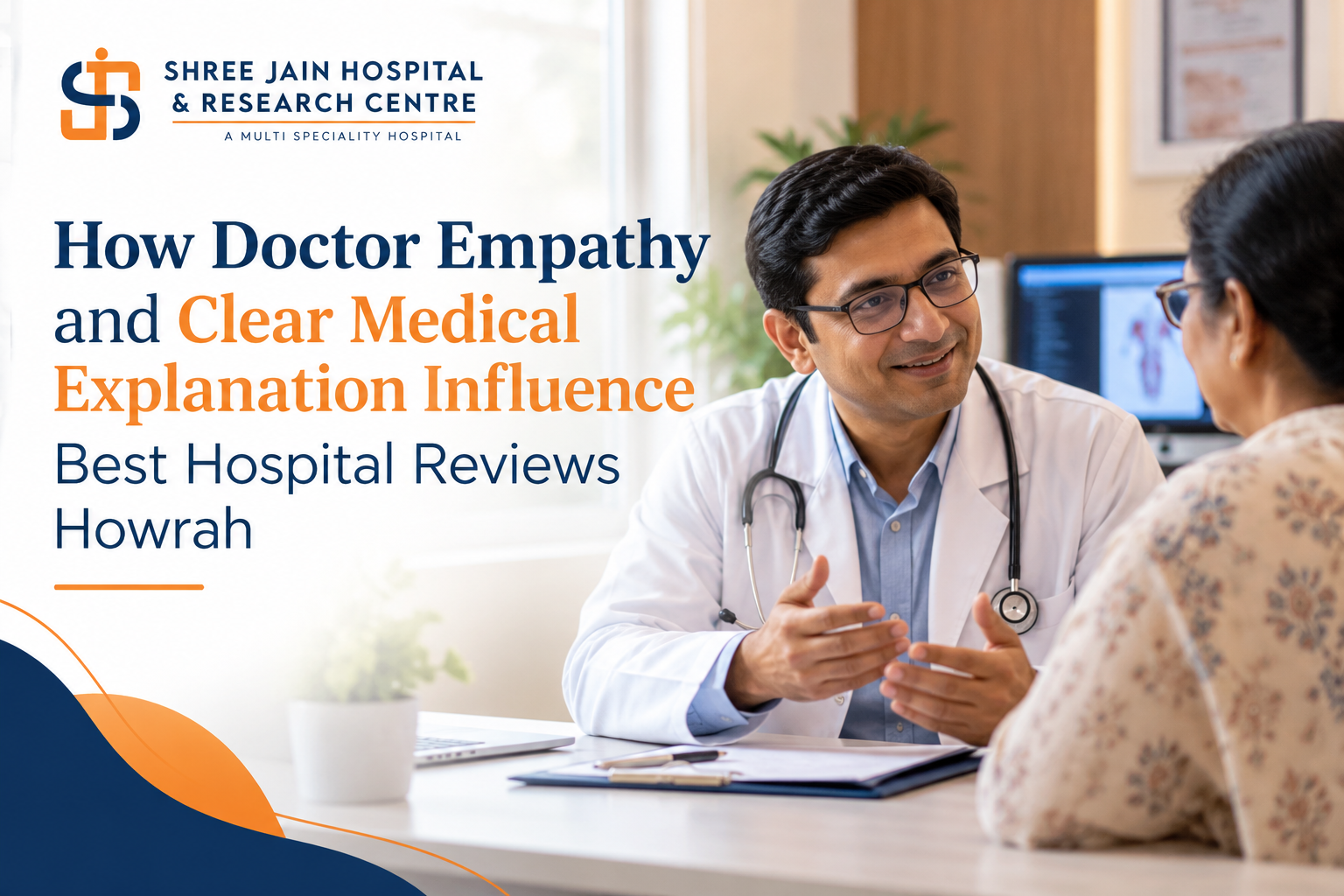
Here’s a scene you can probably picture without any help. A man in his fifties sits outside a consulting room in Howrah with a folder of reports he doesn’t fully understand. His daughter is holding the prescriptions. The doctor is good, properly good, and the visit lasts six minutes. In the corridor the daughter asks, “So what did he say?” Nobody is quite sure.
(That’s a composite, not a real patient.)
We’d argue that the corridor question is where a lot of hospital reviews begin. Not in the operation theatre, not in the lab. It’s why the best hospital reviews Howrah patients trust usually talk about being listened to and being told things plainly, well before they mention any machine.
This article is about those two things, empathy and explanation. We’ll go through what the research says, where it can go wrong, and what patients can do on their side of the desk. We’ll also say how we look at it at Shree Jain Hospital and Research Centre in Shibpur, which is reachable from both Foreshore Road and GT Road and runs under the S.S. Jain Sabha.
Who Reads Reviews, and What Are They Looking For?
Start with the habit itself. Before booking anything, plenty of people check what others said. A US survey reported by [Healthcare Innovation](https://www.hcinnovationgroup.com/population-health-management/patient-engagement/news/13027701/survey-most-patients-use-healthcare-review-sites-to-choose-docs ) found that 77 percent of respondents used online reviews as the first step in finding a new doctor. Another, covered by [Medical Economics](https://www.medicaleconomics.com/view/physician-reviews-patients-increasingly-consult-online-ratings-when-choosing-doctor ), had nearly 70 percent calling reviews and star ratings extremely or very important. Those are American numbers, and we’d be careful about pasting them onto Howrah. The Indian picture is murkier. An editorial by Indian orthopaedic surgeons in the [Journal of Orthopaedic Case Reports](https://jocr.co.in/wp/?p=76064 ) says online reviews are gaining influence but still trail surgeon reputation, hospital infrastructure, cost and referrals.
So what are reviewers actually looking at? In the Healthcare Innovation report, accuracy of diagnosis led at 43 percent. Listening skills came next at 20 percent, then explanation skills at 16. Think about that for a second. A patient has no way of checking a diagnosis. Listening and explaining, though, they can judge almost immediately.
That’s why the best hospital reviews Howrah residents can lean on read like small observations. The doctor sat down. The nurse answered the same question twice without sighing. Someone from the ward came to the family with news before they had to go hunting for it. Bad reviews often read as the mirror image, a list of things that didn’t happen.
What Empathy Actually Looks Like in a Consultation Room
Empathy gets praised a lot and described very little, so let’s describe it. The doctor sits down. They let the patient reach the end of a sentence. They say the worry out loud, the one the patient hasn’t managed to voice, which is quite often money, or a lost day’s wages, or who’s collecting the children from school. If the family is here under Swasthya Sathi, those worries can sit right beside the diagnosis in importance, and a doctor who brings them up first saves everyone an awkward minute.
There’s evidence behind this. A review by Dr. G. Swaminath in Indian Journal of POsychiatry in 2007 (https://www.ncbi.nlm.nih.gov/pmc/articles/PMC2902081/ ) collected works which are associated with emphatic communication with good clinical results, better compliances, less patients going doctor to doctor, and less malpractice complaints. One of the study also showed that patients observed the empathy by the doctor and being a partner in the decision making, which results in satisfaction and compliances more than the information data they are given.
If you work in a hospital, read that last part twice. More information, on its own, didn’t do the job.
Can you teach it? Cleveland Clinic tried. In the [Journal of General Internal Medicine](https://journalclub.wustl.edu/?p=36660 ) study, 1,537 attending physicians sat through an eight-hour communication course and 1,951 didn’t. Afterwards the trained group scored 92.09 on patient-rated communication and the others 91.09. That’s a small gap, and it was an observational study, not a randomised trial, so don’t oversell it. It is important statistically, but the experts in this field also experienced less burnout and higher empathy.[Becker’s Hospital Review](https://www.beckershospitalreview.com/quality/hospital-physician-relationships/cleveland-clinic-study-shows-communication-skills-training-improves-patient-satisfaction/ ) has a readable summary. Separately, a study reported by [Becker’s Physician Leadership](https://www.beckersphysicianleadership.com/physician-workforce/study-physician-empathy-leading-cause-of-satisfaction-for-chronic-pain-patients/ ) surveyed 1,352 people with chronic back pain and named physician empathy and communication as the leading cause of higher satisfaction.
Our own reading? Empathy can be trained, but in that study a whole course moved the score by about a point. If a hospital wants more of it, it has to live in routine: how OPD slots are built, how rounds are run, who gives news to families.
Explanation Is Half the Job
Kindness only gets you so far. A warm doctor who says “renal impairment” and moves on has still left someone confused, and the patient will probably nod anyway, because who wants to ask a doctor to repeat themselves?
How big is the gap? An Agency for Healthcare Research and Quality data spotlight, reported by [HPN](https://hpnonline.com/patient-satisfaction/article/21074589/ahrq-data-spotlight-reveals-a-dearth-of-adult-health-literacy-and-a-proven-solution ) and based on 2015 US survey data, found that only 12 percent of adults had proficient health literacy. We haven’t found a comparable Indian figure, so treat that number as a warning light, not a measurement of Howrah.
The fix the [AHRQ](https://www.ahrq.gov/health-literacy/improve/precautions/tool5.html ) recommends is called teach-back, and it’s almost embarrassingly simple. You explain something important, then ask the patient to tell you in their own words what they’re going to do. If they get it wrong, your explanation has failed, not them. Say it differently and ask again. AHRQ’s materials tie the method to better understanding and better medication adherence. They also admit it feels slower at first. The argument is that misunderstandings eat far more time later.
Honesty belongs here too. “We don’t know yet, but this is how we’ll find out” lands better with a family than a confident guess. So does a straight answer, early, on how long the stay might be and roughly what it will cost.
Four Conversations That Decide a Review
Here’s a way of looking at a hospital stay that we find useful. To the hospital it’s one admission. To the family it’s a handful of conversations, and we’d argue reviews tend to be won or lost in them. To be clear, this is our own framework, built from the research above. Nobody has tested it. The review wording in the last column is made up to illustrate.
| Conversation | What the patient needs to leave knowing | Where it can slip | How a review might read |
| First consultation | What the problem probably is, which tests come next, a rough cost | Jargon, and no pause for questions | “Listened without rushing” or “No one explained the tests” |
| Update after a procedure or overnight | How it went, what to watch for, who to ask | The family waits in the corridor with no news | “Kept us informed” or “We kept asking at the desk” |
| Money and scheme eligibility | What a scheme covers and what it doesn’t, before admission | A surprise at the billing counter | “Told us clearly” or “Found out at the counter” |
| Discharge | Medicines, diet, warning signs, follow-up date, a number to call | Instructions given once, fast, to a tired family | “Clear plan at discharge” or “Had to call back about the dose” |
How We Look at This at Shree Jain Hospital
[Shree Jain Hospital and Research Centre](https://jainhospitalhowrah.com/shree-jain-hospital-howrah/ ) was set up by the S.S. Jain Sabha as a charitable hospital, and it is empanelled under both the West Bengal Health Scheme and Swasthya Sathi. For a family admitted under a scheme, the money conversation in the table above is a practical question, not a side issue. They need to know what’s covered before admission, not at the counter.
The [dialysis unit](https://jainhospitalhowrah.com/dialysis-center-howrah/ ) is a good place to see why repeated contact matters. By the hospital’s own figures it runs around 100 sessions on an average day and was upgraded to treat up to 35 patients at the same time. People on dialysis come back several times a week, for months or years. That’s a lot of chances to spot a swollen ankle, or a patient who has gone quiet. Explaining things there isn’t one conversation. It’s the same conversation, adjusted, over dozens of visits.
The [facilities](https://jainhospitalhowrah.com/facilities/ ) page lists a multi-speciality OPD, emergency and ambulance services that run round the clock, a pharmacy open 24 hours, radiology and pathology diagnostics, and nearly twenty departments, from cardiology and nephrology to paediatric and spine surgery. With Deutsche Cleft Kinderhilfe, the hospital also provides cleft palate surgery for children at no charge. Think about the parents there. Every step is a decision, and every decision needs somebody to explain it.
If you’re searching for the best hospital reviews Howrah has on offer, don’t stop at the star count. Read several platforms and, if you can, ask someone who has been a patient what was explained to them. That test applies to us too.
How to Get Clearer Answers as a Patient
You can’t control how a doctor communicates. You can make it easier for them to do it well.
Organise and write the questions before leaving home, as if you want to remember them, it will not come to your mind the moment you step outside. You need to take everything from the past medical journey, reports, prescriptions, tablets you are taking , even something if it is from another doctor. A doctor can evaluate well if everything is there in his table. If you are unwell, or anxious to gather everything, ask for help who can listen to you and take notes accordingly.
Begin with the frightening things you don’t want to encounter, even if they are small, tell it. If something the doctor says is not clear, ask him to tell again in a different or in easier way, whatever suits you best, and then repeat it in your own words so that you both can be on the same boat. That is actually beneficial to the doctor too as they can understand what they are saying is ok with you also. Before standing, check with three things you can answer, what is wrong? What to do next? When will be the revisit?
Write the plan down afterwards, or photograph the prescription and any instructions. If something changes at home, like a fever that returns or a new symptom, ring the hospital instead of waiting for the next appointment. The 24-hour helpline numbers are +91-33-2641-5831 and +91-33-2641-5809.
And if you write a review, be specific. Say whether the doctor listened, whether the explanation made sense, what you were told to do next. “Excellent hospital, five stars” helps nobody. A few honest lines about what happened help the next family, and give the hospital something it can fix.
What Hospitals Should Do With Reviews
Patients do notice replies. A survey summarised by [CXM](https://cxm.world/cxm-news/online-reviews-matter-more-than-referrals-in-healthcare/ ) found that 45 percent were more likely to choose a doctor who responds to feedback online, and 40 percent had cancelled or rethought an appointment after reading negative comments. In another, covered by [Medical Economics](https://www.medicaleconomics.com/news/physician-reviews-patients-increasingly-consult-online-ratings-when-choosing-doctor ), 51.8 percent of patients who posted a negative review said nobody contacted them about it. None of that was measured in Howrah, so take the numbers as a direction, not a forecast.
What makes a reply good? Short, specific, no excuses, and a direct number to call. What makes it useful is what happens next. Take a complaint like “nobody told us anything after the surgery”. It’s tempting to file that under rude staff. It may well be a missing routine. Somebody has to own the post-procedure update, and once somebody does, that review stops repeating itself.
Frequently Asked Questions
Why do reviews talk so much about the doctor’s manner?
Because it’s the part patients can judge. Most people can’t assess a surgical technique, but they know straight away whether they were heard and whether the explanation made sense. The Healthcare Innovation survey above lists listening and explanation skills among the things patients look for.
What is the teach-back method?
It’s a simple check. The doctor or nurse explains, then asks you to say it back in your own words. If it doesn’t come out right, they explain again, differently. The Agency for Healthcare Research and Quality recommends it.
Does doctor empathy improve treatment results?
The evidence is firmer for satisfaction and for sticking to treatment advice than for clinical outcomes. A 2007 review in the Indian Journal of Psychiatry links empathic communication with both. Treat that as supportive evidence, not proof of cause. Empathy doesn’t replace medical skill. It makes good treatment easier to follow.
How can I judge a hospital before I visit?
Read recent reviews on more than one platform and look for specifics rather than star counts. See whether the hospital replies. Check the departments, emergency cover and schemes it accepts. And if you can manage it, sit in the OPD for ten minutes and watch how staff talk to people.
Does Shree Jain Hospital accept Swasthya Sathi?
According to the hospital website, Shree Jain Hospital and Research Centre is empanelled with both the West Bengal Health Scheme and the Swasthya Sathi scheme. Eligibility and procedures can vary, so confirm the details with the admission desk before treatment.
How can I contact the hospital?
The 24-hour helpline numbers are +91-33-2641-5831 and +91-33-2641-5809. You can also write to contact@jainhospitalhowrah.com or admission@jainhospitalhowrah.com.
Conclusion
People forget the name of the procedure. They remember how they were spoken to. If the doctor listened and the family walked out knowing what happened next, that’s what gets written down, and it’s why the best hospital reviews Howrah families post read like accounts of conversations, not audits of equipment.
If you run a hospital, take the four conversations above and check each one for teach-back. If you’re a patient, ask your questions, say what scares you, and be specific when you review.
And if you or someone at home needs care, the team at [Shree Jain Hospital and Research Centre](https://jainhospitalhowrah.com/ ) in Shibpur, Howrah, is reachable on the 24-hour helpline, +91-33-2641-5831 or +91-33-2641-5809, or at contact@jainhospitalhowrah.com for appointments and questions about departments and services.