


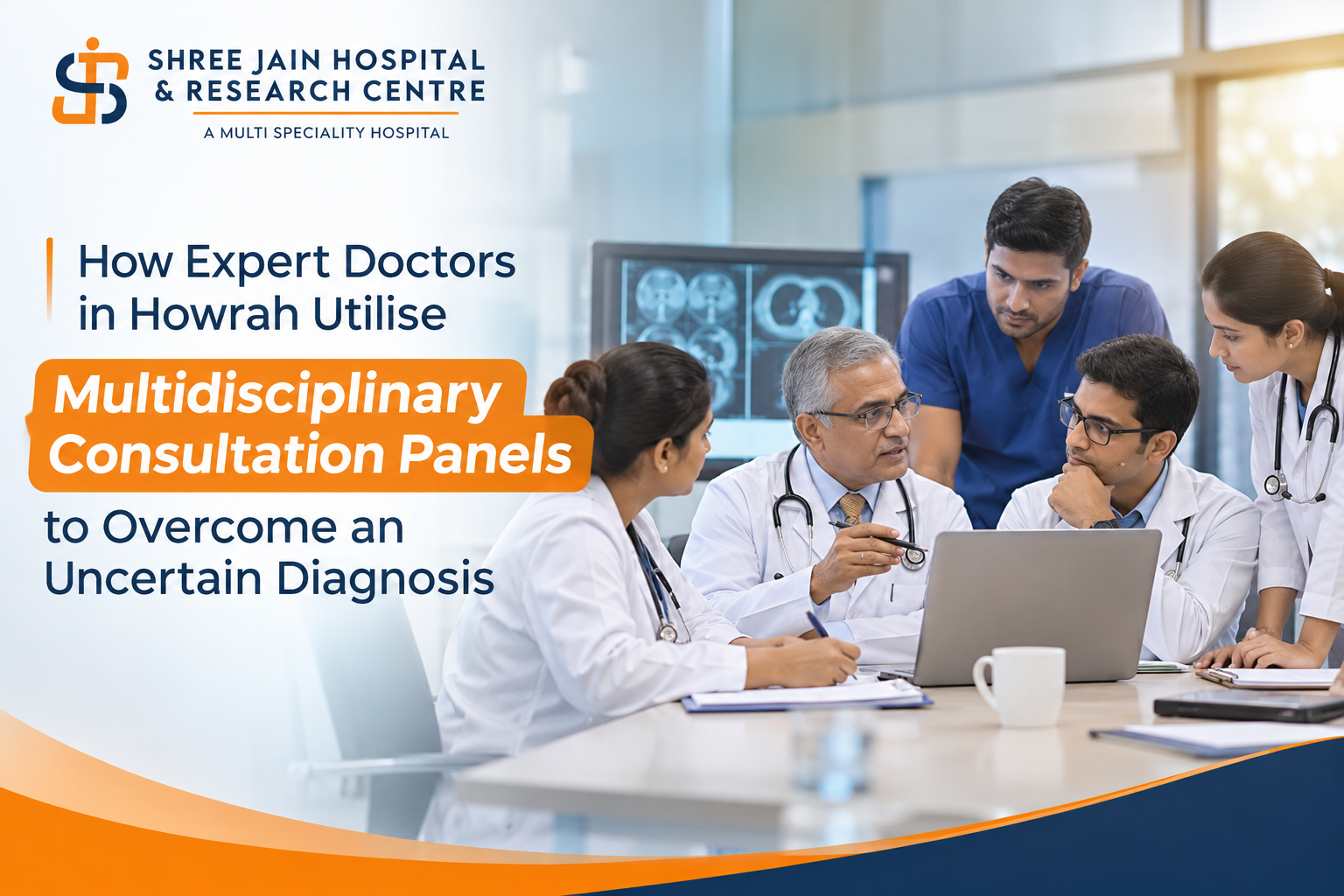
Whilst one doctor can often provide a likely diagnosis, another may specialise in a different area leading to an alternative conclusion. As problems can have shared symptoms, and solutions are continually adapted, frequently a person will experience an evolving diagnosis. Despite a professional’s knowledge and skill, the human body does not naturally categorise itself into medical sectors so sometimes a more holistic approach is required.
Shree Jain Hospital and Research Centre (Shibpur, Howrah) utilises multidisciplinary consultation panels. Doctors from various specialisms come together to discuss a patient’s information. Members of the panel analyse data, question and cross-reference information to agree on a robust diagnosis. Compared to simply being told ‘we are not sure’ or ‘let’s monitor the situation’, this method allows a patient to benefit from the combined skills of a range of professionals.
Why people commonly face an uncertain diagnosis
Whilst the majority of uncertain diagnoses are not due to a lack of medical expertise, there are several reasons why someone may experience this. Firstly, different health conditions can lead to similar symptoms. Neurological issues can for instance, initially manifest as a gut related complaint. Similarly, cardiac concerns can resemble both anxiety and acidity. Furthermore, early reports may not be sufficiently informative. Investigations such as scans and analyses can also be open to differing interpretations.
Compartmentalisation is also a key issue. Individuals may visit different healthcare professionals; for example a neurologist for headaches, a gastroenterologist for nausea and an orthopaedic surgeon for back pain. Although each professional is highly knowledgeable within their sector, rarely will all aspects of a patient’s health be analysed simultaneously. Without this holistic analysis, a person’s diagnosis remains partial and management tends to be experimental.
Studies have shown that many people seeking a second medical opinion subsequently receive an altered or further developed diagnosis. Within complex areas of medicine, in around 20% of cases an individual’s diagnosis evolves. Again, this is not to suggest that the original diagnosis was incorrect. Structure and collaboration are especially advantageous within these types of scenario.
What a multidisciplinary consultation panel entails
Contrary to a notion that such a panel involves medical professionals analysing hypothetical cases, a multidisciplinary consultation is a real process. Relevant healthcare professionals are provided with a patient’s information which encompasses medical history, examination notes, laboratory results, imaging and histology along with previous management. Each doctor analyses this from their own professional standpoint. Subsequently, the panel meet (face-to-face or in a structured manner) to analyse, query and agree a diagnosis.
The Shree Jain Hospital medical staff draw upon a wide range of medical expertise. Comprising over 100 qualified consultants and doctors, the hospital is multi-disciplinary and includes specialisms such as neurosurgery, cardiology, gastroenterology, orthopaedics, pediatrics, ENT, neurology, pulmonology, gynaecology and general medicine. Where appropriate, a panel can access the relevant medical professions to analyse a patient’s situation. Unlike self-arranged secondary opinions, the patient does not need to make multiple appointments and re-relay their information.
Analysis of a complex case
Typically, a summary of a patient’s issue will first be compiled by the attending doctor or the hospital’s medical profession. The panel then sequentially analyses the information. Which health condition(s) is/are suggested by a patient’s symptoms? What do investigative results confirm and deny? And what further analysis is required?
Should images be difficult to interpret, the radiologist will analyse and explain these. Likewise, if histology is equivocal, the pathologist will detail what can and cannot be ascertained from it. Should surgical advice be required, the surgeon will decide whether surgery is indicated based on the analysis.
Unlike a generic recommendation of ‘further analysis is required’, the panel then agrees a provisional diagnosis. Reasons for this are analysed and recommendations for further investigation are identified. Additionally, the panel agrees on management. If, however, the information does not conclusively support a diagnosis then this is highlighted. The panel also identifies what should be observed and/or investigated next. This is extremely valuable as it enables a patient and their family to understand and follow a clear course of action.
Expert Doctors Howrah and overcoming an uncertain diagnosis
As previously mentioned, the quality of a multidisciplinary panel is dependant on the medical professionals involved. Within Shree Jain Hospital, the medical profession comprises highly qualified and experienced consultants. Neurosurgeons, for example, are qualified to MS, MCh and have gained international fellowships. Moreover, the neurosurgery section has its own neurosurgical theatre, Zeiss neuro microscope and C-arm. Imaging is also conducted in-house using a CT scanner, colour doppler and x-ray. Other sections including cardiology, gastroenterology, pediatrics and orthopaedics also have similarly high calibre professionals. Automated pathology analysis and 24 hour diagnostic facilities further underpin medical expertise.
Expert Doctors Howrah are therefore pivotal within this process. Again, as noted above, the standard of a panel is dependent on the nature of queries which are raised. Highly skilled medical professionals are able to distinguish between misleading and pertinent information. They are also adept at recognising trends which may elude others. As all these experts are part of the same hospital, the panel can reconvene as new information is received and refine a diagnosis in light of this.
Areas most suited to a multidisciplinary analysis
Whilst not all patients require a multidisciplinary analysis, typically simple issues such as a broken bone or infection do not. However, this method is particularly valuable where individual medical professionals continue to struggle to formulate a cohesive diagnosis. Typical areas requiring such an analysis include:
Neurological issues – for example, persistent headaches, fits and/or limb weakness where scans are inconclusive. Neurosurgery, neurology and radiology can work together to differentiate between mechanical and non-mechanical neurological concerns.
Cardiac concerns – for example, chest discomfort and/or shortness of breath which cannot be explained by an electrocardiogram and basic echocardiogram. Cardiology, pulmonology and general medicine can then analyse to identify alternative causes.
Gut related issues – for example, chronic gut discomfort, unexplained weight loss and/or liver related concerns which straddle gastroenterology, general surgery and oncology.
Paediatric concerns – children often exhibit different symptoms. Medicine, surgery and neonatology paediatric professionals can analyse a child’s growth, development and specific organ related concerns.
Orthopaedic pain – where x-ray and standard imaging results do not correspond with an individual’s pain levels. Orthopaedics, physiotherapy and neurology can then collaborate to exclude pain referral and/or neurological issues.
Once again, a multidisciplinary panel does not supplant the attending doctor. Rather it augments their diagnostic analysis.
Is Shree Jain Hospital able to manage complex diagnostic analysis?
Comprising 130 inpatient beds and 20 ICU beds, the hospital has in-house CT scanning, MRI, digital x-ray, ultrasound and colour doppler technology along with automated pathology analysis. Doctors are also available in numerous specialisms including neurosurgery, cardiology, gastroenterology, orthopaedics, pediatrics, ENT and others. Such resources allow the hospital to effectively carry out and analyse complex diagnostic analysis internally and without external delays.
Value of a multidisciplinary analysis
For those who have already incurred time and costs in attending various medical appointments without achieving a definitive diagnosis, a multidisciplinary analysis can offer additional value. Rather than a further secondary opinion, it allows a structured collation of diverse professional opinions.
Commonly asked questions
Does everyone at Shree Jain Hospital undergo a multidisciplinary analysis?
No. Only those with complex or uncertain diagnoses, and for whom an individual medical professional has been unable to confidently establish a diagnosis, undergo a multidisciplinary analysis. Standard medical care is provided for more routine health concerns.
How long does a multidisciplinary analysis usually take?
This is influenced by the extent of a patient’s information and the number of medical professionals involved. Generally, once sufficient information has been gathered, a multidisciplinary analysis is conducted as part of the hospital’s medical process. Priority is given to urgent cases.
Can patients independently request a multidisciplinary analysis?
Patients can raise the possibility of a multidisciplinary analysis with Shree Jain Hospital’s attending consultant. If appropriate, the hospital’s medical profession will then organise a multidisciplinary analysis.
Does a multidisciplinary analysis supersede the attending doctor?
No. Rather, a multidisciplinary analysis supplements an attending doctor’s analysis to arrive at an agreed diagnosis. The attending doctor retains overall responsibility for a patient’s care and management.
Is Shree Jain Hospital able to manage complex diagnostic analysis?
As detailed above, the hospital possesses the resources to effectively manage complex diagnostic analysis internally.
Conclusion
Whilst an uncertain diagnosis can be disconcerting, it often indicates that a more holistic analysis is required. Shree Jain Hospital and Research Centre’s multidisciplinary consultation panels are designed for exactly such scenarios. Whether information is equivocal, whether more than one medical profession is involved or whether a person simply requires a definitive course of action rather than further appointments, this process allows a group of Expert Doctors Howrah to cohesively analyse a patient’s situation. For both Howrah and indeed the wider region, such an analysis can transform an often lengthy and uncertain period of time into a management strategy founded on a range of professional medical expertise.
If you or a family member are receiving varying information or are experiencing an uncertain diagnosis, please contact the Shree Jain Hospital and Research Centre clinical team in Shibpur, Howrah. Telephone 03326415831 or visit jainhospitalhowrah.com to ascertain whether a multidisciplinary analysis would be suitable for your circumstances.