
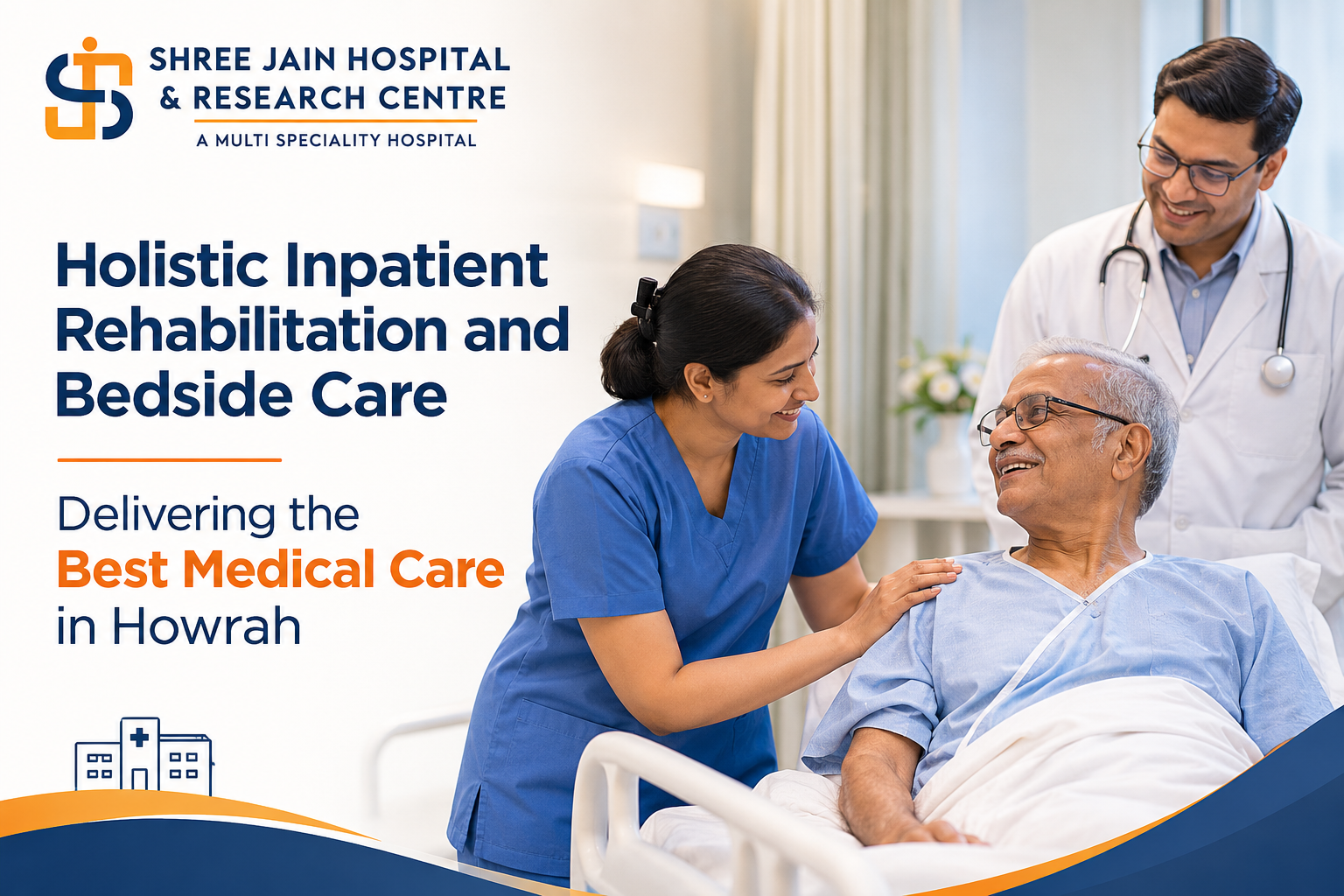
Recovering from a health condition is a significant process. Whether you are helping a loved one regain mobility following a stroke, or watching your partner recover to sit after surgery, true recovery begins once the acute stage of the condition has passed. To reflect this, inpatient rehabilitation at Shree Jain Hospital and Research Centre includes attentive support throughout. If you are looking for Best Medical Care in Howrah, we provide attentive support throughout inpatient care to maximise recovery.
Approximately 10% of strokes occur in India per year. After initial treatment, many of these patients require intensive rehabilitation for several weeks. Similarly, patients with orthopaedic injuries, neurotrauma, weakened muscles after surgery and protracted illness will follow a similar pattern. However, inpatient recovery can be lengthy. Therefore, inpatient holistic rehabilitation and attentive care is key for these patients.
What is Holistic Inpatient Rehabilitation?
Holistic inpatient rehabilitation means that recovery is prioritised in all aspects of inpatient care.
Within our 130 bed super speciality hospital in Shibpur, inpatient rehabilitation is provided as soon as the patient is stable. For stroke patients, we check for recovery of function in multiple areas (swallowing, speech, bladder control, skin health, nutrition, and readiness) following the stroke. Within joint replacement recovery, patients are given tailored exercises and taught how to sit up, move around to the toilet and climb stairs safely. Within neurological recovery, minor changes are monitored to ensure independence can be maintained.
This is very different to simple inpatient care. Although the phrase ‘Best Medical Care in Howrah’ is often used, we believe that true recovery should be considered as a clinical outcome.
Attentive care
Despite having experienced surgeons and advanced imaging techniques, recovery is heavily influenced by small interactions during attentive care. Dignified care, prevention of complications and increasing confidence can all be achieved with attentive care.
At Shree Jain, attentive care involves more than taking patient vitals and administering IV fluids. Our nursing and paramedical staff are trained to monitor subtle clues. A change in fluid request, tiredness in a family member and improving wounds but a change in mood. Patients are turned regularly to prevent pressure sores. Patients are given guidance to stand up from sitting following surgery. We work with dieticians to ensure patients receive nutritious foods to aid recovery.
Relevance in Howrah
Most people in Howrah cannot access a rehabilitation centre, and may lack the resources to provide appropriate recovery in the home. Therefore, inpatient recovery is very important for people within Howrah.
Tailored recovery plans
All recovery plans are tailored to the individual.
Function oriented
To create a recovery plan for each individual, we consider what they need to be able to do upon discharge. Are they living alone? Is there a toilet on the same floor? Do they need to return to a sedentary occupation, a retail role or a manual occupation? A stroke sufferer who regularly climbs stairs will have a different recovery plan compared to a retired patient who needs to move around safely in indoor environments. This recovery plan takes into account our extensive knowledge and experience in post discharge recovery.
Interdisciplinary
Recovery plans at Shree Jain involve multiple disciplines working together. Physiotherapy, occupational therapy, speech & swallowing therapy, nursing, dietetics and specialist medical review all contribute to recovery. Due to this teamwork, the physiotherapist will know what the nurse observed overnight, the doctor will know what concerns the family members have, and the dieticians will know what the patient can eat. As a result, recovery becomes a co-ordinated process.
Functional outcomes
Rather than simply measuring range of movement and strength, we aim to improve functional outcomes. Can the patient feed themselves, sit up independently, toilet independently, and be understood well enough when speaking? These are key outcomes to be reached before discharge. Best Medical Care in Howrah is determined by the number of functional tasks patients can perform, rather than the number of tests performed.
Family involvement
Recovery is a family process. Therefore, families are considered part of the care team.
We train a family member to assist with safe movement, positioning in the home, and symptoms to be aware of. Medications are explained in an easy to understand manner. Caregivers are shown how to help the patient walk without causing back problems. If the family fully understand the recovery plan, going home is no longer scary.
As multi generational families are common in this area, this is extremely relevant for many patients. If a patient goes home to an untrained family, they often come back. However, if they go home to a trained family, they continue making progress.
Needs we support
- We provide inpatient rehabilitation with attentive care to support many different needs. Some common needs include:
- Stroke/Neurological Recovery: Early mobilisation, speech & swallowing therapy, re-training bladder/bowel function, and family education to maintain independence at home.
- Orthopaedic Recovery: Recovery after joint replacement, fracture and spinal surgery to allow safe movement and completion of daily tasks.
- Weakness after Surgery: Structured progression to walking from bed, with consideration to wound care, nutrition and pain management.
- Neurological Conditions: Parkinson’s Disease, spinal cord injuries and others affecting mobility, balance and independence.
- Long term inpatient stays: Functional assistance before discharge from chronic illness.
- All recovery plans are tailored to the individual.
Why we can provide holistic care
We are able to provide holistic care in inpatient care.
We have inpatient physiotherapy, advanced imaging, including CT scanning and MRI, a 24hr pharmacy, and one of the highest volume dialysis units in Howrah. We are on panel with the West Bengal Health Scheme and Swasthya Sathi, meaning eligible patients can receive care with less of a financial burden on families, reducing the likelihood of reduced recovery. Inhouse radiology and pathology means recovery plans can be altered with little delay.
Equally importantly, we are familiar with long inpatient stays. As we have 169 beds, recovery is very common at this hospital. Nurses know when to push patients, and physiotherapists have helped hundreds of people complete their initial steps.
| Recovery goal | What we check at the bedside | Why it matters |
| Safe mobility | Sitting balance, transfers, walking with or without support | Reduces falls after discharge |
| Self-care | Feeding, grooming, toilet use | Builds independence at home |
| Communication and swallowing | Speech clarity, safe swallow | Lowers risk of choking and isolation |
| Skin and positioning | Pressure areas, turning schedule | Prevents sores during long stays |
| Family readiness | Caregiver training, warning signs | Lowers readmission risk |
Recovery continues after discharge
Although we aim to provide the best rehabilitation, we do not aim to get patients out of hospital quickly. Instead, we measure successful rehabilitation by looking at how well they do in the weeks after discharge.
Before discharge, we give a clear recovery plan to families to follow. We inform them of any follow up appointments. We inform them what progress to expect and when to contact the hospital. If ongoing physiotherapy is required, we can help the patient understand their options. We ensure quality care continues even after the patient has left.
Frequently Asked Questions
How long is inpatient rehabilitation?
For stroke recovery, patients often require 6-8 weeks of structured rehabilitation. For orthopaedic recovery, this may vary dependant on which surgery and the individuals general health. Regular reviews take place to adapt the recovery plan.
Can families be involved in inpatient care?
Yes. We encourage one family member to complete key elements of the care plan before discharge. This reduces anxiety in the patient at home and reduces admission rates.
Are you on panel for Swasthya Sathi and WBHS?
Yes! Shree Jain Hospital and Research Centre is on panel with both the West Bengal Health Scheme and Swasthya Sathi. We can help you understand whether you qualify and complete any documentation.
Is inpatient rehabilitation only for stroke recovery?
No. Inpatient rehabilitation and attentive care is available for orthopaedic, post surgical weakness, neurological conditions and long stays in hospital. We tailor recovery plans to functional goals.
Where is the hospital located?
We are based in Shibpur, Howrah. We are easily accessible by Foreshore Road and GT Road.
Conclusion
Recovery is made up of small steps. Many of these steps occur during physiotherapy sessions, however many are made with the support of carers and nurses. Inpatient rehabilitation and attentive care have been carefully designed to support these small steps. We do not view rehabilitation as a service within the hospital – we view it as the reason we exist.
If you or a loved one require Best Medical Care in Howrah, please get in touch! We would be happy to talk to you in person, or through phone, or you can ask your treating doctor. The sooner recovery begins, the more of life you can get back.