


You ever notice how hospital waiting rooms have a certain smell? Not bad, just… specific. I’ve spent two decades walking past those plastic chairs at Shree Jain Hospital and Research Centre, a Top Surgical Hospital Howrah, and if I’ve learned one thing, it’s that most people sitting there with back pain never had a real accident. It was always a desk. A chair. A way of working that nobody ever stopped to question.
A Young Man and His Blue Plastic Stool
There was this kid. Twenty-six. Skinny, quiet, came in with his father. He worked as a freelance graphic designer, the type who never sees daylight because his clients are in different time zones. He told me, in this almost embarrassed voice, that his right foot had started dragging. Like it didn’t want to lift. He could still feel it, but it moved a split second late, as if the message from his brain was getting stuck somewhere.
I remember the surgeon on duty that day, a lady who’s been doing this so long she can read an MRI faster than I can read a headline. She asked him what he sat on at home. He said a plastic stool. One of those round ones, the kind you see outside a chai tapri. He’d been using it for two years. His laptop was on an old wooden crate. Two years. On a stool with no back support. The disc in his lower back didn’t just bulge—it fragmented. A tiny piece broke off and pressed into a nerve. He needed surgery. Not because he lifted something heavy. Because he sat on a stool and never moved.
The surgeon didn’t yell at him. She just said, very softly, “Your discs were hungry.” The kid looked at her like she’d lost her mind. I understood the feeling.
Why Your Discs Are Starving Right Now
I’m going to explain something that still messes with my head even after all these years. The discs between your vertebrae, those little cushions, they have no blood supply. No veins, no arteries. They survive entirely on motion. Think of a kitchen sponge. When you squeeze it under water, it soaks everything up. When you release it, the dirty water comes out. That’s what your discs do when you walk, twist, bend, even fidget. Squeeze and release. That’s how they eat. That’s how they stay alive.
Now picture yourself sitting for six hours without moving. That sponge isn’t getting squeezed. It’s just sitting there, drying out, getting brittle. Tiny cracks form on the outside. None of this hurts. Not at first. Then one day you reach across the table for a salt shaker, or you twist to pick up a towel you dropped, and the inside of the disc pushes through those cracks and smacks into a nerve. You’ll swear the salt shaker did it. The salt shaker was just the unlucky one.
I read a piece on BBC Worklife ages ago about how the pandemic turned everyone’s kitchen tables and ironing boards into offices (source: [BBC Worklife](https://www.bbc.com/worklife/article/20210122-the-home-working-back-pain-epidemic ). They tracked a massive spike in back pain cases. I didn’t need the article to confirm it. I was already watching it flood through the doors of this Top Surgical Hospital Howrah.
The Two Things Your Chair Actually Needs
Everyone thinks they need a chair that costs a month’s salary. They don’t. I’ve seen people get relief with a rolled-up bath towel. Seriously.
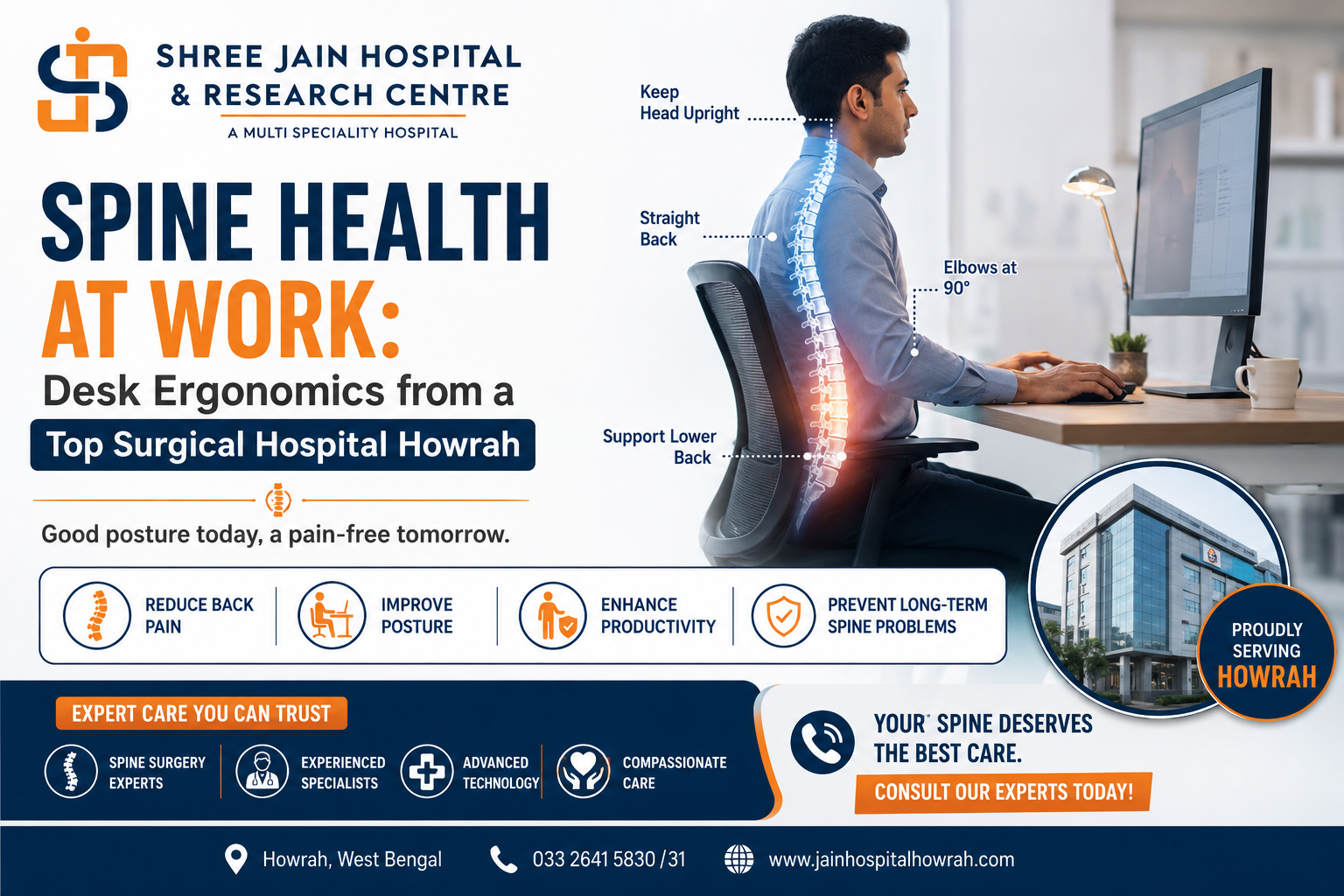
Your chair needs to do two things. First, let you put your feet flat on the floor. Not dangling, not tucked under your thighs. Flat. Second, it needs to support the inward curve of your lower back, the bit just above your belt. If the chair doesn’t have that support, shove something in there. A towel, a small cushion, whatever. That tiny bit of pressure stops your pelvis from rolling backward. And when your pelvis rolls back, your lower spine flattens, and the pressure inside your discs goes through the roof. That’s the whole secret. Feet flat. Lower back filled. Done.
That Laptop Is Doing Damage You Can’t See
Laptops are a disaster for necks. There’s just no kind way to say it. The keyboard and the screen are stuck together, so you can’t have both in a good position at the same time. If the keyboard feels right, the screen is way too low. Your chin drops. Your head creeps forward. And for every inch your head moves ahead of your shoulders, the weight your neck muscles have to carry nearly doubles. It’s a mean little fact of physics.
The fix is almost stupidly simple. Find a stack of books. An old shoebox. Anything stable. Put your laptop on top so the screen is near eye level. Then plug in a cheap external keyboard and mouse. That’s it. Your neck straightens up, your shoulders drop back, and those pounding headaches that used to arrive every afternoon start to fade. I’ve seen this work more times than any pill.
The Timer Trick Nobody Bothers With
I get it. You’re in the zone. You don’t want to break concentration. But remember those starving discs? They don’t care about your deadline. They need movement. Not exercise, just movement. Every thirty minutes, stand up. Walk to the kitchen. Look out the window. Put your hands on your lower back and lean backward a little, just until you feel a mild stretch. For your neck, pull your head straight back like you’re trying to make the silliest double chin of your life. Hold it a few seconds. That’s it. That’s the whole routine. Takes less than a minute.
Set a timer on your phone. A loud, annoying one. Do it. Your spine will thank you in twenty years.
Don’t Shrug Off What Your Body Is Saying
A stiff neck at the end of the day. A dull ache across the lower back that disappears by morning. A little tingling in the fingers that comes and goes. I’ve seen smart people ignore these things for months, years. They call it work stress or getting older. It’s not. It’s a message. The body is tapping you on the shoulder.
When the pain starts to travel down an arm, down a leg, that’s a problem. Pins and needles in your toes. A hand that feels clumsy. A foot that catches the floor when you walk. That means a nerve is being squeezed. Nerves are patient, but they’re not infinitely forgiving. If you ever lose control of your bladder or bowels, don’t call for an appointment. Just go to the emergency room. That’s a surgical emergency, no two ways about it.
Surgery Is the Last Hand We Play
At Shree Jain Hospital and Research Centre, the surgeons I’ve worked with for years don’t love the operating theatre. They’re good at it, don’t get me wrong. But they’ll try everything else first. Physiotherapy. Guided injections. Rehab. Most people get better without a scalpel anywhere near them. It’s only when the weakness is progressing or the pain has eaten a person’s entire quality of life that surgery becomes the right call.
Even then, they use minimally invasive techniques. Small cuts, less bleeding, faster recovery. The standing of a Top Surgical Hospital Howrah doesn’t come from racking up numbers. It comes from people walking out of the building with their lives back.
A Last Thought from Someone Who’s Seen Enough
The spine isn’t fragile. It’s tough as old boots. It handles bad posture, cheap mattresses, long car rides, and all the other nonsense we throw at it. But it keeps a ledger. Every day of neglect gets noted. A chair that fits, a screen at eye level, a timer that forces you to get up these aren’t big heroic acts. They’re boring little habits. But they’re the only thing between a healthy back and a surgeon’s consultation room. I’ve sat in too many of those rooms already. I’d rather you never have to see one.