

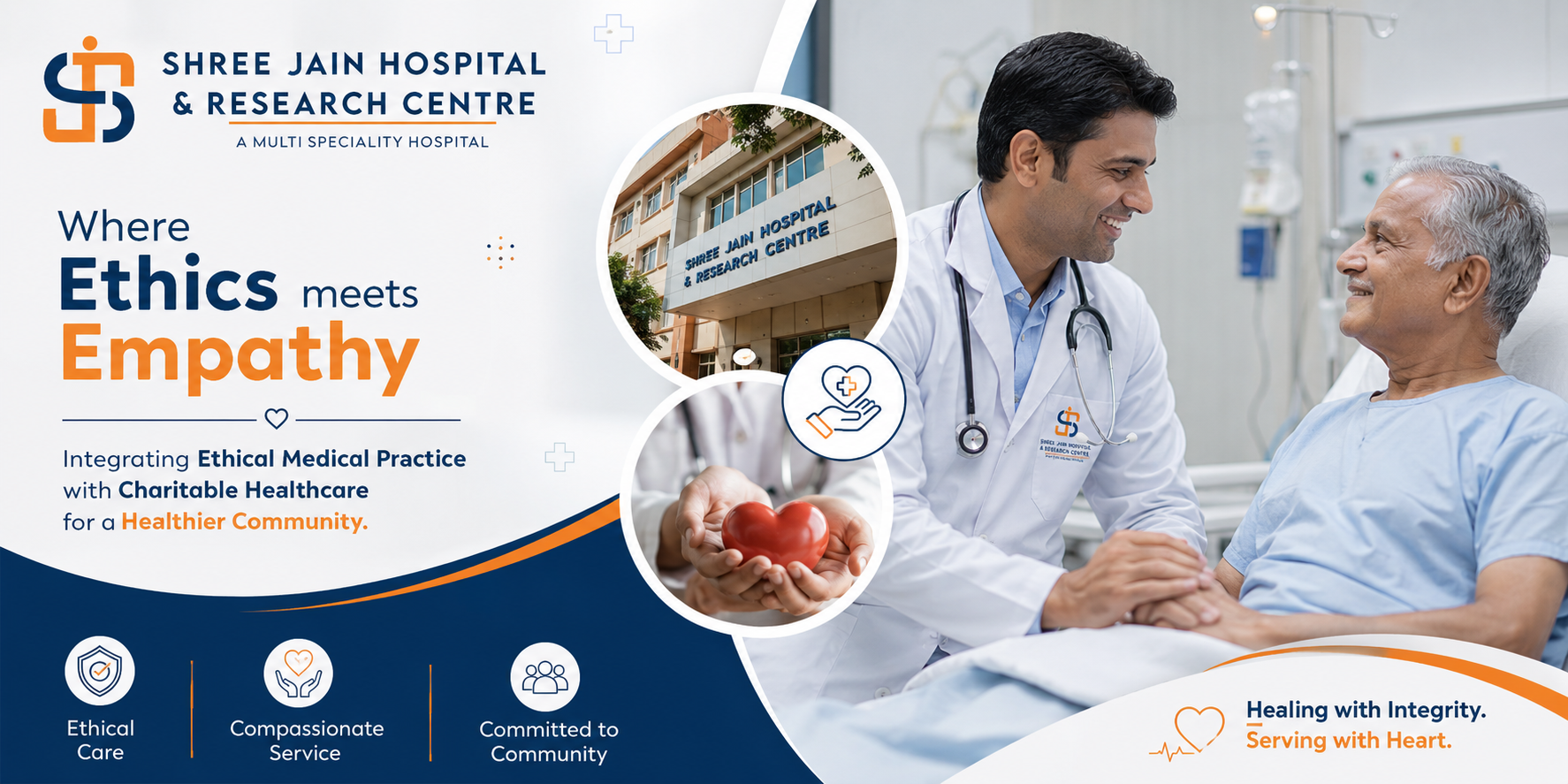
Most people, when they walk into a hospital, aren’t thinking about ethics. They’re worried. In pain. Holding a hand. Hoping the doctor will really listen and that the bills won’t break them. That’s the truth. The philosophy, the big words—that’s meant to be our job, not theirs.
Our team at Shree Jain Hospital and Research Centre has been at this for a little over twenty years now. Right here in Howrah. And when people describe us as a Renowned Hospital in Howrah, I hope they’re not just thinking about the machines or the big names on the board. I hope they mean something quieter. That we can be trusted when it counts.
Let me try to explain what that trust looks like from the inside. Not a list of policies. Just a regular day.
Honest medicine, in practice, is actually pretty quiet
On a Tuesday, ethical practice doesn’t announce itself. It sounds like a senior doctor telling a junior, “We don’t need that scan, the ultrasound gave us enough.” Or a young woman at the billing counter walking an elderly patient over to the pharmacy instead of pointing vaguely down the hall.
We do follow all the formal guidelines—the National Medical Commission’s code is always somewhere on a committee desk. But honestly? The real ethics is in those tiny, almost invisible decisions. Not ordering tests for the sake of it. Admitting we want a second opinion. Telling a family, “Look, you could take that package, but the simpler option is just as good and costs less.” That’s the daily integrity we try to protect.
Of course, the pressure is always there. A busy Renowned Hospital in Howrah can easily slip into a rhythm of doing more, billing more, moving people through faster. We’re not saints. But we’ve built enough small checks—random billing audits, mandatory second opinions on high-cost procedures, a committee that debates tough cases—to catch ourselves before ego takes over.
Charity is not just a camp. It’s a bed with clean sheets.
I often feel people get the wrong idea about “charitable healthcare.” They picture a tent, a queue, maybe a photo for the local paper. We do those camps too, but that’s not the heart of it.
The real charity at our hospital is almost invisible. It’s the woman from a village outside Howrah who needed an ovarian cyst removed and went home a week later without paying a single rupee. It’s the rickshaw puller who got cataract surgery in the same operating theatre as our private patients, with the same sterilization drill. No separate queues. No lower-grade treatment.
We run a dedicated charitable ward and we cross-subsidise heavily. When a paying patient chooses a private room, a part of that margin funds a bed for someone who can’t pay. The balance can get tight some months. But after twenty years, the numbers tell us we’re still doing okay with numerous free admissions last year and multiple free major surgeries. Those aren’t just statistics. They’re people who didn’t have to sell something precious to get well.
The tricky part isn’t money though. It’s making sure the person who arrives with nothing never feels like a burden. You can’t teach that in a policy document. You have to live it until it becomes muscle memory.
A small story that stayed with me
A few months ago, neighbours brought in a labourer in his late fifties. He had been ignoring a gallbladder problem for so long it had turned dangerous. He was terrified. Not of the operation—of the cost.
Our social welfare team assessed his situation in a couple of hours. No endless forms. No humiliation. By the next morning he was on the surgery list. The surgeon who did his laparoscopic cholecystectomy was the same person who had handled three paying cases earlier. Same gloves, same skill, same aftercare. The only difference? A billing file quietly marked “zero.”
When he was leaving, he said something to the nurse that I keep coming back to. “Didi, I thought I’d have to sell my cycle. I got to keep it.” That cycle is his livelihood. That moment, more than any plaque on the wall, explains why we do this.
Trust gets built in the little things
People sometimes ask me what makes a **Renowned Hospital in Howrah** different from any other big building full of doctors. I think it’s how you handle money and information.
We hand over itemised bills before anyone asks. Consent forms are explained in Bangla or Hindi, not just signed with a nod. Our treatment package rates are pinned near the reception—no hidden numbers. And if someone files a complaint, it lands on my table, not in a forgotten box.
We’re an open book for anyone who wants to check. Our charitable reports are available, registrations are current, contact numbers are real. You can visit. You can talk to a former patient. That kind of transparency doesn’t cost a rupee, but it’s probably the most valuable thing we offer.
Learning never stops
I’d be lying if I said we have it all figured out. Medicine shifts fast. So we push our team to stay current—consultants go for refreshers, junior doctors sit through CMEs, and we have an antibiotic stewardship programme that, over two years, cut unnecessary broad‑spectrum antibiotic use by more than 30%. That’s an ethical win too, because we’re not just protecting one patient. We’re protecting the whole community around Howrah from resistant bugs.
We also learn from our stumbles. Every quarter, the clinical audit meeting can get a bit uncomfortable. But that discomfort is exactly where expertise grows. It’s how a decent hospital becomes a careful one.
Frequently Asked Questions
Does a poor patient really get the same doctor?
Yes. Our consultants rotate through all wards—charitable and private. There’s no secret “junior doctor only” rule for free patients. I personally operate on quite a few charitable cases, and my senior colleagues do too.
How can I know a test is truly needed?
You can ask. A good doctor should be able to explain clearly what a test is looking for. If they brush you off or get defensive, that’s a warning sign. We try to make “why this test?” a normal part of every conversation.
Can this model keep going?
Some years are leaner than others. But after two decades in Howrah, we’re still here, still expanding, still treating patients from all income levels. The cross‑subsidy approach works if you run things efficiently and keep your intentions in the right place.
A last thought
When we started this hospital, we weren’t chasing recognition. We just wanted a place where a mother from a village and a businessman from the city could both walk in and feel seen. Not as cases. As people.
That, to me, is what it means to weave ethical practice and charitable care together. It’s not about being saintly. It’s about being steady. Not about grand gestures, but about the hundred tiny choices made every single shift by nurses, ward boys, billing clerks, and doctors. For anyone looking for a Renowned Hospital in Howrah that tries hard to do things the right way, we’ve been here, quietly, for twenty years.
If you or your family ever need care and you’re somewhere near Howrah, our doors are open. Come see the place. Speak to someone who’s been here before. We’ll do our best to give you the same honest, respectful treatment we’d want for our own.
You can find more about our charitable work or reach our helpdesk at https://jainhospitalhowrah.com/ . Sometimes the surest way to trust a hospital is just to visit it. We’d be glad to meet you.
Written by: The Medical Team, Shree Jain Hospital and Research Centre
A group of doctors and specialists who have served Howrah and surrounding communities for over a decade.